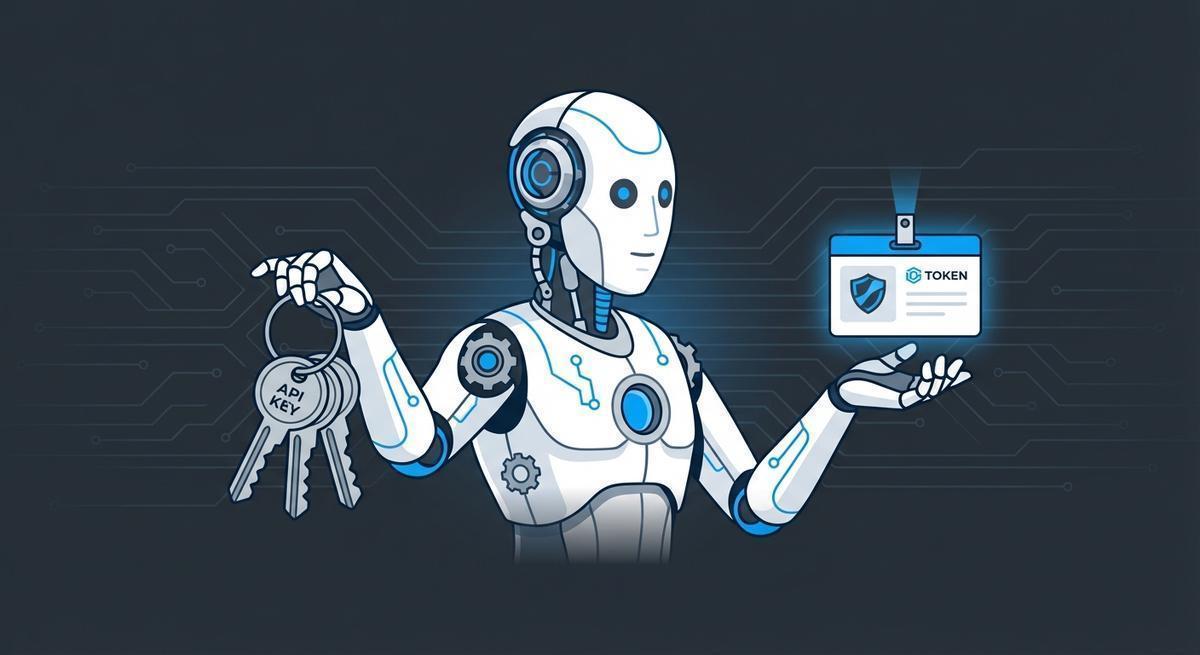
Your AI agent probably authenticates with a static API key stuffed into an environment variable. Maybe it’s in a .env file. Maybe it’s a Kubernetes secret. Either way, it’s a long-lived credential that never expires, can be copied, and will eventually leak.
This is how we’ve always done it for humans at keyboards. It’s not how services should authenticate to each other in 2026.
The Pattern That Keeps Causing Incidents
Static API keys were designed for human developers testing APIs. You generate one, paste it into a curl command, and move on. The problem is that teams have been copy-pasting this workflow into production AI agents, and the threat model is completely different.
A human rotating keys has intent and context. An AI agent running on a schedule does not. When that key leaks, through a log, a crash dump, a compromised dependency, or a supply chain attack, it stays valid until someone notices and rotates it. That window is your blast radius.
The LiteLLM supply chain incident demonstrated this clearly: a compromised package grabbed environment variables, including every API key the agent had access to. Static credentials are all-or-nothing. Once they’re out, they’re out.
How Modern Services Authenticate
Kubernetes workloads, GitHub Actions runners, AWS Lambda functions: none of these use long-lived API keys to authenticate to each other. They use workload identity.
The concept is straightforward. Instead of a credential you generate once and store forever, your workload gets a short-lived cryptographically signed token that proves its identity based on where it’s running. The token expires in minutes or hours. If it leaks, the attacker has a narrow window before it’s worthless.
OIDC (OpenID Connect) is the protocol most platforms have standardized on. Your workload requests a token from the platform’s identity provider. The receiving service validates the token’s signature and claims. No static secret changes hands.
SPIFFE (Secure Production Identity Framework For Everyone) takes this further, giving each workload a cryptographic identity document called an SVID. It rotates automatically. Your workload never holds a long-lived credential at all.
GitHub Actions already does this for AWS, GCP, and Azure. Your CI pipeline can write to S3 without storing an AWS access key anywhere. The runner gets a short-lived OIDC token, exchanges it for AWS credentials scoped to the job, and those credentials expire when the job ends.
AI agents can use the same model. They should.
Why AI Agents Are Stuck on Static Keys
The honest answer: tooling hasn’t caught up yet.
Most AI agent frameworks assume you’ll pass credentials as environment variables or config files. LangChain, CrewAI, AutoGen, the OpenAI Assistants API: they all expect a key string. There’s no built-in concept of “fetch a short-lived token before each request and refresh it when it expires.”
Some cloud-hosted agents get workload identity for free if they run on Lambda or Cloud Run with the right IAM setup. But agent-to-agent calls, or agent-to-third-party-API calls, still fall back to static credentials most of the time.
The other problem is that OIDC requires the receiving service to support it. Most external APIs don’t. Stripe doesn’t hand out OIDC tokens. OpenAI doesn’t accept SPIFFE SVIDs. The identity standards exist at the infrastructure layer, not at the API-product layer.
Your agent's .env file is a countdown timer.
Static keys never expire. Short-lived session tokens do. Stop treating agent credentials like developer API keys.
No credit card required
The Bridge Layer
This is where a proxy fits. If your agent’s requests flow through a layer that understands workload identity, that proxy can handle the translation. The agent authenticates to the proxy with a short-lived token tied to its workload identity. The proxy validates the token, applies policies, and forwards the request to the upstream API with whatever credential that API requires.
The upstream API key lives in the proxy, not in the agent. The agent never touches it. If the agent is compromised, an attacker gets a short-lived token scoped to specific operations, not the raw API key with full access.
This is related to the phantom token pattern, which separates the internal token from the external credential. We’ve written about deploying that approach in production at https://www.apistronghold.com/blog/phantom-token-pattern-production-ai-agents. The same principle applies here: don’t let the agent carry the secret. Let it carry a reference.
What the Migration Looks Like
You don’t have to flip a switch. Most teams migrate gradually.
Start by centralizing. If your agents are currently reading API keys from environment variables scattered across deployments, pull those into a single secrets manager or proxy. This doesn’t fix the static-key problem yet, but it shrinks the blast radius: now there’s one place to rotate and one place to audit.
Next, add token-based authentication at the proxy layer. Your agent authenticates to the proxy with a short-lived token (even a simple JWT with a short expiry is better than a never-expiring key). The proxy handles the upstream credentials. You’ve now decoupled agent identity from upstream credentials.
Then, where your infrastructure supports it, swap the agent’s token for a real workload identity. If the agent runs on Kubernetes, use a service account OIDC token. On AWS, use an IAM role. On GCP, use a service account with Workload Identity Federation. The proxy validates these tokens natively; no custom credential management needed in the agent.
Each step reduces exposure. You don’t need to complete the migration before you get value from it.
The Goal
An AI agent should carry nothing that lasts longer than a single session. Its identity should be cryptographically tied to where it’s running and what it’s allowed to do. If it’s compromised, the attacker gets a token that expires in fifteen minutes and can only call the specific APIs that agent is authorized to use.
That’s achievable today for infrastructure-layer calls. For third-party APIs, the proxy layer bridges the gap while the ecosystem catches up.
Static API keys in agent environment variables are technical debt. They’re also a security liability. The model exists to fix this; most teams just haven’t applied it yet.
Ready to stop hardcoding API keys in your agents? API Stronghold proxies agent-to-API traffic with short-lived token auth, policy enforcement, and full audit logging.
Short-lived tokens for every agent session. No .env required.
Each workflow gets credentials scoped to what it needs, expiring when it's done. The bridge layer your agents need while the ecosystem catches up.
No credit card required